
Food
How to Order Hotpot Without Speaking Chinese
A practical guide to choosing broth, ordering ingredients, handling raw food and paying for a Chongqing hotpot meal.
Choose your broth, order in rounds and ask staff for help cooking unfamiliar ingredients.
- Most hotpot menus are tick-sheets with pictures. Pointing is a completely normal way to order.
- Ask whether sauce, broth and tableware have separate charges before ordering.
- There is no universal safe cooking time in seconds: ingredient thickness and temperature matter.
- Pay at the end at the counter, or from your phone. Tipping is not expected.
This is a description of how the meal works generally, not a specific restaurant's process.
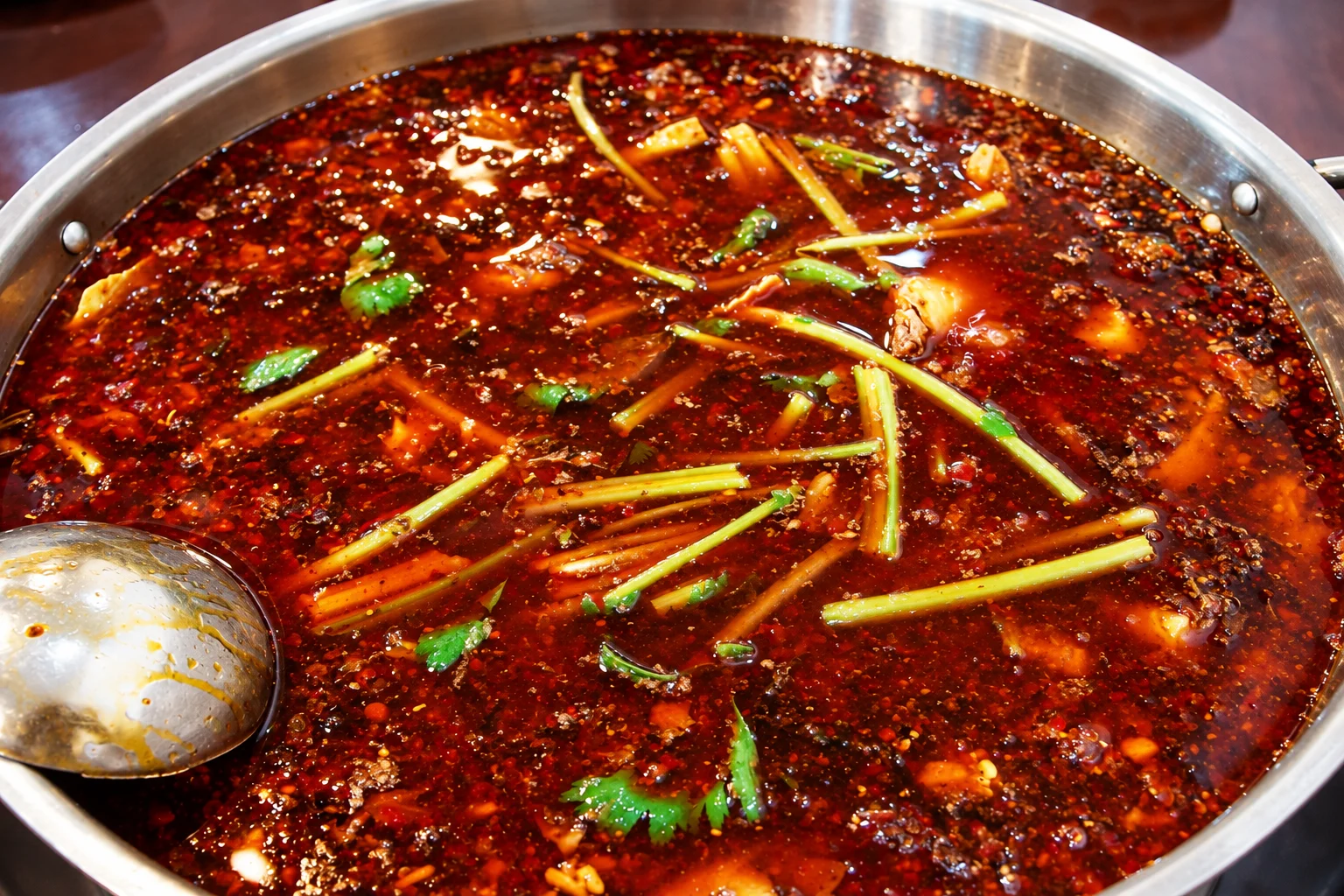
The meal, step by step
Choose your pot
You will be asked about the broth before anything else. "Yuanyang" gives you a divided pot with a plain half and a spicy half. If you are unsure, choose this.
Tick the menu
Order in waves rather than all at once. Start with two or three meats and a couple of vegetables, then add more once you know how fast you are eating. Over-ordering is the common first-timer mistake.
Build your sauce
Go to the sauce station while the pot heats. A good starting bowl: sesame oil, garlic, coriander, a little soy, and a spoon of chilli oil only if you want it. The oil is the point — it cools the food and carries flavour.
Cook in the right order
Ask staff how to cook each ingredient. Keep raw-food utensils separate from eating utensils, avoid overcrowding the pot, and do not rely on meat changing colour to judge whether it is safe.
Finish with starch
Noodles or rice at the end, cooked in what is left of the broth. This is the traditional finish and it is the best part for many people.
Pay at the counter
Payment is at the till on the way out, usually by phone. If you can read the total on the screen, you can pay it; if not, show the number to the staff.
Cooking safely
A fixed seconds-per-item chart cannot establish that meat is safely cooked. Colour and texture alone are not reliable indicators. Food safety guidance uses internal temperature, measured with a food thermometer.
Ask staff to help with unfamiliar meat, offal and seafood. Use separate utensils for raw ingredients and cooked food. If you cannot confirm how an item should be cooked, choose a dish prepared by the kitchen instead.
If you do not read Chinese
Menus generally have photographs. Point at three or four, then add more once you see the portion sizes.
For spice, the useful phrase is the same one used for any dish: be clear about the broth before the pot arrives, because it cannot be changed afterwards.
Camera translation works well on hotpot menus because the items are short and the pictures give context.
Common questions
How much should I order for two people?
What if I order too much?
Is the sauce station extra?
Can I get a non-spicy pot?
Related guides
Food
Chongqing Hotpot
The dish the city is built around: what it actually is, how it differs from the versions you have eaten elsewhere, and how to have a good first experience rather than a memorable bad one.
View guideConfirm practical detailsFood
Chongqing Noodles (Xiaomian)
The city's breakfast, its cheapest meal and arguably its most representative food. If hotpot is what Chongqing is famous for, xiaomian is what it actually eats.
View guideConfirm practical detailsFood
Where to Eat in Chongqing: Food Areas
Which parts of the city to walk when you are hungry, what each is good for, and how the terrain affects a decision that sounds like it should be simple.
View guideConfirm practical detailsTravel Essentials
Payments in Chongqing for International Visitors
Alipay and WeChat Pay run almost everything here. How to get them working before you arrive, what still takes cash, and the failure modes that leave people stuck at a till.
View guideConfirm practical details
Useful sources
Primary source
- Food Thermometers
USDA FSIS · checked 3 Oct 2026
About this information
- Food Thermometers: Supports thermometer use and the limits of colour as an indicator of safe cooking; does not verify restaurant customs or individual dishes.